
Key points
- There is a mismatch between the public’s perceptions of what influences health (namely individual behaviour and access to care) and the clear evidence base demonstrating the significance of wider determinants of health.
- In this long read we draw on polling and recent research to explore the reasons behind public attitudes towards health and health inequalities. We look at how public health professionals can use communications techniques to improve public understanding of evidence about health inequalities.
- Research shows that people tend to filter nuanced messages about health through either an individualistic or ecological (structural) lens. Understanding how these different mindsets can promote – or obscure – people’s awareness of the significance of social determinants is an important first step in developing effective ways of framing the evidence.
- We should be aiming to shift more people towards the ecological mindset, while also being wary of a possible sense of inevitability or disempowerment at the scale of complex systemic challenges. To achieve this, we can learn from the recent change in dialogue on climate, and use tangible examples showing structural inequalities (relatable case studies cut through).
- Anyone delivering public health messages must take time to understand how their messages land with the public. With health in the public eye like never before, the forthcoming outputs of our ‘Thinking differently about health’ project (with the FrameWorks Institute) will help public health professionals build better public understanding of health inequalities.
When asked what influences their health, the British public consistently point to two things – their individual behaviour, and their ability to access health care. This has been shown time and again over the last 5 years, from British Social Attitudes polling in 2017, to Ipsos polling commissioned by the Health Foundation in late 2021. Yet for decades there has been clear evidence that the building blocks of health are wider ranging. Factors such as housing, education and employment are pivotal in shaping individual opportunities to be healthy and play a stronger role in maintaining good health than access to the NHS.
This mismatch between public perceptions and the evidence has consequences. Public opinion shapes political decision making. In the face of life expectancy stalling, and falling for some, a sustained focus on policies to enable people to stay healthy for longer is paramount. Our analysis finds that this will require greater public buy-in for policies that go beyond the role of the NHS. Which in turn, will require advocates to find more effective ways to communicate to the public.
This long read explores reasons behind current public attitudes towards health and inequalities in health outcomes, drawing on polling and public attitudes research by the Health Foundation and others. It considers the role of communication approaches in bringing closer alignment between public understanding and the evidence, referencing findings from the Health Foundation’s ‘Thinking differently about health’ project with the FrameWorks Institute, full findings of which will publish later this month. Sign up for updates on this work.
Health inequalities – does the public know or care?
The scale of health inequalities is a surprise to many – and disbelieved or rejected by others
Public polling was conducted with Ipsos between 25 November and 1 December 2021, with 2,102 responses from people aged 16 and older across the UK via Ipsos’ KnowledgePanel. While this polling points to most of the UK public being aware of inequalities in health outcomes, a substantial minority of people think there are no differences in health between different groups. Almost 1 in 5 people (17%) do not think there are differences in health by sex or gender, and around 1 in 8 (13%) do not think there are differences by ethnicity.
Even among the majority who recognise that health inequalities exist, many are surprised by the extent of them when presented with the data. As part of our COVID-19 impact inquiry, we commissioned work with Kantar Public to explore public understanding of inequalities in health (both inequalities relating to COVID-19 as well as inequalities that existed before the pandemic). A cross-section of the public from across the four UK countries took part in virtual workshops in early 2021. Most participants were unaware of the extent of inequality in health outcomes, particularly the unequal COVID-19 mortality among different groups. Some readily accepted the information but went on to explain it through their own confirmation biases. For example, some participants explained the differences in mortality rates between men and women in terms of men visiting the doctor less, being less hygiene conscious and being less compliant with the rules. Others, where the data challenged their world view, wanted more detail. Their questioning implied a scepticism in the way data had been calculated, that figures were being ‘rounded up’, and drawing a distinction between people who had ‘died with’ rather than ‘died of’ COVID-19.
The role of individual behaviour in COVID-19 outcomes was referenced consistently, whether in terms of individual actions to control exposure to the virus, such as hand washing, or in emphasising existing behaviours which may underlie someone’s health status, such as people who took more exercise being generally fitter and less likely to have a worse outcome from the virus. These explanations convey a desire to see control resting with the individual, consistent with a previous meta-ethnographic study of people’s understanding of inequalities in health. This study found that despite people who live with socioeconomic disadvantage having a good understanding of the links between socioeconomic hardship and ill health, they are often reluctant to explicitly acknowledge these inequalities in health outcomes. The researchers suggested this could be understood as an attempt to resist the stigma and shame of poverty and poor health and to assert (or reassert) individual agency and control.
Some people are concerned about health inequalities, but levels of concern vary depending on how data are presented
In February 2021, a study of public attitudes after COVID-19 by King’s College London found that 81% of people surveyed said it would be a very big or fairly big problem if inequalities in life expectancy worsened between more and less deprived areas of the country. 76% said it would be a very big or fairly big problem if inequalities in life expectancy worsened between rich and poor.
Health Foundation polling with Ipsos in November to December 2021 also found not just concern, but appetite to address this. Around two-thirds of the public (69%) agreed that the government should aim to reduce inequalities in health between different groups. The poll found differences in health between those on different incomes (75%) and those living in different geographical areas (72%) were considered the most important for government to address. There was also substantial support for action in all the other areas asked about: 69% thought there should be action to address health differences by education level, 65% thought there should be action to address health differences by ethnicity, and 57% thought there should be action to address health differences by gender or sex.
This apparent high support for action on health inequalities contrasts with a separate question in the King’s College London study. When asked to choose three or four areas of inequality considered to be most serious from a list, only 28% of the public cited ‘health inequalities and life expectancy’ as one of the most serious challenges to Britain. Other types of inequalities generated much more concern, with inequalities between ‘deprived and well-off areas’ (61%), and ‘income and wealth’ (60%) being considered the most serious.
This suggests that when ‘health inequalities’ are not portrayed as the result of the other types of inequality that cause them, they are considered less serious. This shows the importance of making the connections between broader inequalities and health inequalities transparent wherever possible.
Who does the public think is responsible for health? And has the pandemic changed people’s views?
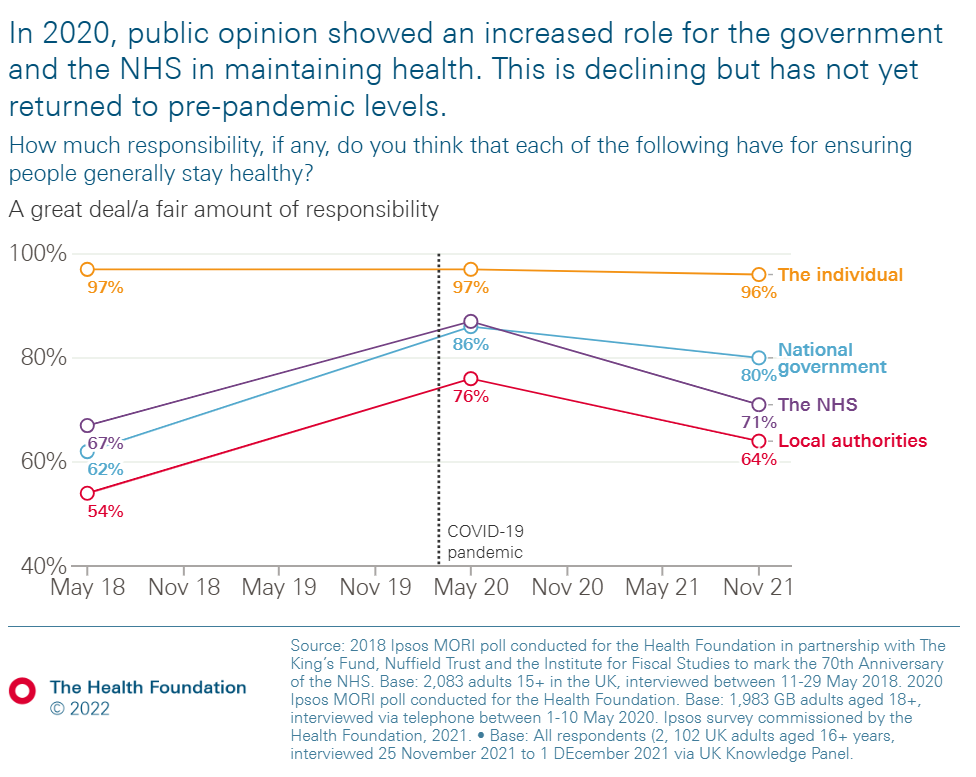
The public has consistently seen an important role for the individual in maintaining their own health. This has barely changed since the first instance of this polling in 2018, when most people (97%) thought either a great deal or fair amount of responsibility for staying healthy lies with the individual (see Figure 1).
During the exceptional circumstances of the pandemic in 2020, there was a substantially higher emphasis on the role that the NHS, local authorities and the government had to play (while people still also felt they had to look after their own health). This emphasis has now declined again, but the most recent polling shows that public’s perception of the role of national and local government in maintaining health remains higher than before the pandemic.
It is still too early to say whether there has been a lasting change in public attitudes regarding the state’s responsibility for people’s health, but the public may now be more receptive to wider government action on health beyond the NHS.
Figure 1
What shapes public attitudes and understanding about inequalities in health?
Different mindsets – is your audience thinking individualistically or ecologically?
The Health Foundation has been working with the FrameWorks Institute to identify better ways of communicating the wider determinants of health – and how these shape inequalities in health.
The research with FrameWorks has found that nuanced messages about health are largely filtered by the public through either an individualistic or ecological strains of thought. An individualistic strain of thought assigns a central role to individual choice and willpower. This line of thinking promotes individual-level responsibility for the choices they make, emphasising use of their own internal resources and experiences, and highly prizing a sense of control.
At the opposite end of the spectrum is the ecological strain of thought which sees health, at least in part, as a product of social and environmental influences. It sees the conditions in which we live, work and grow as crucial in our ability to stay healthy. With an ecological strain of thought it is easier to see the multiple conditions necessary to enable health, from cheap healthy food promoted on the shelves to good employment opportunities which allow people to live well.
This finding also was reiterated in the work mentioned previously with Kantar Public for our COVID-19 impact inquiry and separately in the work by King’s College London on public perceptions of broader inequalities.
Both the individualistic and the ecological (or structural) mindset can acknowledge elements of the other, and indeed can be present in the same people at different times, but they are strikingly contrasting ways of thinking. Work by King’s College London on broader inequalities found that around a third of people polled were at each end of the spectrum (individualists 29%, structuralists 32%). However, the biggest proportion (39%) were in the middle, acknowledging a mix of both drivers.
Our work with the FrameWorks Institute suggests shifting more people into the ecological mindset should be seen as an aim.
Disempowerment and fatalism – losing a prized sense of control
Shifting people towards an ecological mindset – which would be more receptive to the evidence base – does come with the risk of creating a sense of disempowerment. When participants in our work with Kantar Public saw the role of wider factors in health, many felt that inequalities in health outcomes were inevitable. The conditions which enable a healthy life were seen to be so unevenly distributed, so rooted in intractable problems of class, race, where and how you live that changing these felt impossible to them. When structural explanations were outlined in the workshops, many participants felt overwhelmed by the challenge of change, depressed and disempowered by what they learned.
Many participants turned to an individual level explanation for differences in levels of deaths between different groups. For instance, one explanation offered for differences in levels of deaths between different ethnic groups was information on hygiene and mask wearing not being communicated in someone’s first language. These simple, single factor explanations which were sought or offered by participants often had single, easily actioned answers – in this case, translating leaflets. By turning to easy actionable answers, participants were able to hold a sense of disempowerment at bay.
In contrast, large scale systemic issues such as income and race inequality seemed intractable. As one participant put it, ‘It’s not surprising. It’s tragic, it’s horrendous, it’s been going on for years…We expect that it will change a little bit but perhaps our expectations are not as high as they should be.’
Many participants felt that suggested policy actions to create shifts them were ‘pie in the sky dreams’. It seems that while it is more straightforward to grasp what is within individual control, more complex systemic issues may be understood but still seen as much harder to change. This suggests that a re-evaluation of communications to the public, especially those with the aim of driving awareness of health inequalities and their wider determinants, would be timely.
Strategies for bridging the gap in understanding
The challenge for public health professionals and those communicating on the wider determinants is evident. The first phase of our work with the FrameWorks Institute noted the mismatch between the public and media’s individualistic way of thinking and the predominate ecological strain of thinking in public health professionals. Along with the suggestions below, forthcoming material will provide an evidence-based approach – in the form of a report, communications toolkit and videos – to support people communicating on these issues. The framing approach centres on making the wider determinants of health more tangible for people by following these steps:
- Start by explaining why the wider determinants of health matter.
- Then ‘go deep’ in explaining the issue to show how and why health is shaped by these wider determinants, and why experiences are unequal across the country.
- Next, keep your communications solutions-focused and explain how these issues can, and should, be solved.
- Finally, bring the key issue into the conversation at the right time and in an appropriate way.
Making the individual part of the structural – learning from the climate agenda
The changing dialogue around the climate crisis in recent years can offer some useful lessons in shifting the public towards evidence-based understanding while not overwhelming them. Initially many people felt the climate agenda was intractable, created by systems and processes that are bigger than them as individuals. Many felt disempowered or fatalistic, or inclined to minimise the problem. Through a combination of repeated, international public explanation of the overall consequences of climate change, alongside both systemic and individual level actions, those with an individualist lens could hold on to a level of personal control, while gaining interest in the wider systemic problem.
Individual level actions alone are not enough to tackle climate change, but it gives individuals a stake in the collective project. The increased public awareness led to increased pressure on policy and corporations – now political parties must take this into account when formulating policy, and companies need to publicly show what they are doing regarding emissions. While still far from its conclusion, the debate has moved to a place where systems change has public support to enable the individual to act, and to push for reform in areas where individuals can’t act.
Making it personal – are your descriptions relatable?
The Health Foundation’s work with Kantar Public showed that relatable examples cut through. One activity used case studies to present experiences of different families from the same town across the income spectrum. Participants could generally relate to one of the families in the case study and the time spent discussing their experiences brought the link between their social circumstances, the pandemic and their health to life. Using case studies was less uncomfortable for participants than discussing their own personal experiences. This suggests using examples and case studies with elements of structural inequalities that the public can relate to from their own lives made the broader issues understandable without reducing them to stories that entirely centred on individual agency. This appeared to provide the public with a strong and relatable reference for understanding structural inequalities.
When context is understood, there is public concern about health inequality. As the focus shifts from the immediate crisis of the pandemic to levelling up outcomes for people, communities and places in the UK, now is the time seek a wider discussion on the underlying inequalities that drive the stark differences in people’s health outcomes.
Our latest research with the FrameWorks Institute has re-emphasised the need for those delivering public health messages to understand how their messages land with the public. Important principles include:
- an awareness of the different mindsets that exist among the public and that many people default to the role of individual responsibility
- avoiding the risk of creating a sense of fatalism and loss of control
- positioning health inequalities as the direct result of wider inequalities
- presenting information in a way that involves stories about people in a context which illustrates the wider determinants.
With the public profile of public health at a once-in-a-generation high, there is a chance for the right messages to land in a way that they may never have done before.
Source: This content was originally published by The Health Foundation. All credit goes to the original author.